How to Manage a Remote Team: 10 Strategies That Actually Work in 2026
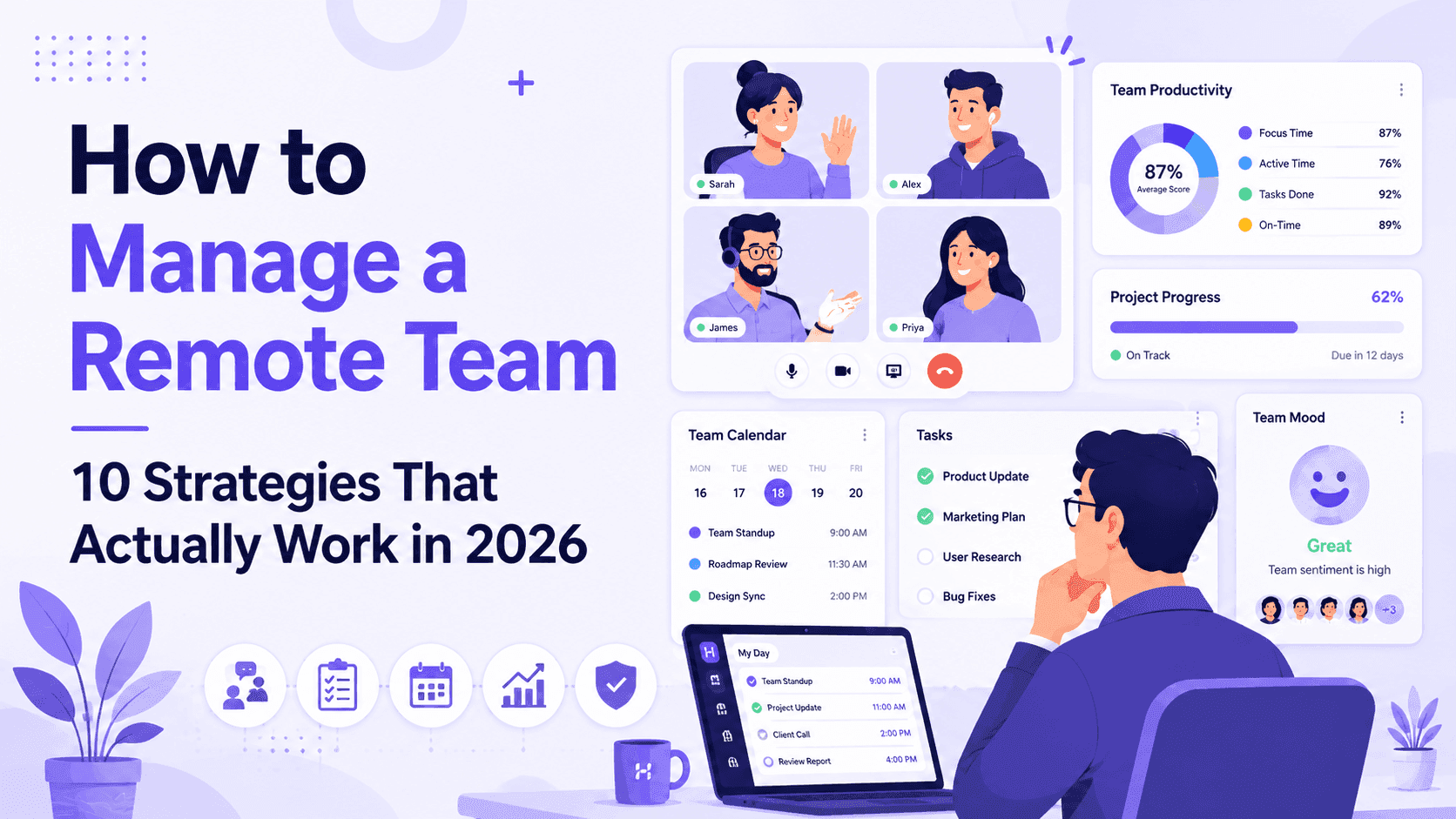
Managing a remote team requires deliberate systems for visibility, accountability, and communication that in-person management takes for granted. Here are 10 strategies that actually work for distributed teams in 2026.
Managing a remote team in 2026 looks very different from the improvised experiment of 2020.
The tools are better, the expectations are clearer, and the managers who struggled through the early years of distributed work have figured out what works and what does not. What has not changed is the core challenge: how do you lead a team you cannot see, maintain accountability without micromanaging, and build genuine performance visibility when everyone is working from a different room or a different country?
This guide covers 10 strategies that actually work for distributed teams, based on how they function in practice rather than how they were imagined to work.
What Makes Remote Team Management Different
Managing a remote team is not office management with video calls added. The absence of physical co-location changes several things that in-person management relies on without realizing it.
Visibility is no longer implicit. In an office, you can see who arrives focused, who looks stressed, who has been staring at the same screen for two hours without making progress. Remote work strips all of that context. You see only what people communicate directly, and a lot of what matters does not get communicated directly.
Communication requires deliberate design. In an office, context flows through hallway conversations, overheard meetings, and incidental interactions. Remote teams only share what they deliberately communicate. Managers who are used to being informed by ambient context have to actively build information flows that do not exist by default.
Trust and accountability work differently. When you cannot see your team working, you have to trust output rather than process. But trust without any verification is not a management system. The goal is accountability grounded in data rather than surveillance.
Strategy 1: Define Work by Output, Not Hours
The instinct when managing remote teams is to measure presence: are they logged in, responding quickly, attending every meeting? This is a proxy for work, not a measure of it.
The more reliable approach is defining what done looks like before the week starts. What deliverables are due? What decisions need to be made? What does a good week look like for each person in terms of output?
This gives employees clarity on what matters and removes the pressure to perform visible presence. It also gives managers a clear basis for feedback grounded in results, not subjective impressions of busyness.
Combine output expectations with time data for a complete picture. Hours alone tell you how long someone worked. Output alone tells you what they delivered. Together, they tell you whether effort is being channeled effectively.
Strategy 2: Default to Asynchronous Communication
Real-time communication feels efficient because it gets an immediate response. At scale, it is expensive: it interrupts deep work, requires everyone to be available simultaneously, and does not produce searchable records of decisions.
Asynchronous communication, meaning written updates, recorded videos, and shared documents, scales better across time zones, creates a searchable knowledge base, and lets people do focused work without constant interruption.
Practical async tools: Loom for short video messages that avoid a meeting, Notion or Confluence for documentation, Slack with clear norms that not every message needs an instant reply, and project management tools where work status is visible without anyone having to be asked.
Real-time communication is still necessary for relationship building, complex problem-solving, and situations needing immediate coordination. Reserve it for those situations rather than defaulting to it for everything.
Strategy 3: Build Meeting Discipline Before Your Team Grows
Meetings expand to fill available time in remote organizations if no one sets constraints. The solution is not eliminating meetings but making the cost of each one explicit.
Before scheduling any recurring meeting, define its specific purpose, what decision gets made or information gets shared, and whether this could be an async message instead.
A useful default framework for teams of 10 to 50 people: one short team-level sync per week for shared context and blockers, one one-on-one per week per direct report for individual support, and project-specific meetings only when a decision needs to be made in real time. Everything else can usually be handled asynchronously.
Strategy 4: Create Visibility Without Constant Check-Ins
One of the most common failures in remote team management is replacing physical presence with a culture of constant check-ins: daily status updates, frequent pings, and repeated requests for progress reports.
This creates the overhead of presence monitoring without any of the natural context that makes in-person oversight efficient. And it signals to your team that they are not trusted to manage their own work.
A better approach: build systems that create visibility passively rather than requiring active reporting.
Daily digest reports from tools like HoraFlow send managers a morning email summarizing the previous day per team member: hours worked, projects logged, productivity score, and any idle alerts. You get the context you need before your first meeting without anyone having to report in manually.
Shared project dashboards in Asana, Linear, or Jira mean no one has to ask where a project stands. The answer is already visible to everyone.
Weekly async updates, where each team member posts a 3-item note at the end of the week covering what they completed, what is in progress, and what is blocked, take 5 minutes to write and give full context without a meeting.
Strategy 5: Handle Shift Workers and Time Zones Deliberately
Managing a remote team across time zones introduces coordination challenges that most general advice on remote work does not address specifically.
Define the overlap window. If your team spans Asia and Europe, there may be only 2 to 3 hours where everyone is available simultaneously. Define that window explicitly and protect it for real-time collaboration. Design everything else to work asynchronously.
Track time correctly across time zones. Standard time tracking tools attribute hours by calendar date, which creates inaccurate records for overnight workers and confusing reports when a manager in one country and a team member in another look at the same dashboard. HoraFlow tracks each employee in their local time zone and normalizes for cross-timezone reporting automatically, so managers always see accurate shift-level data regardless of where the team is based.
Account for calendar and cultural differences. Public holidays vary by country. Working norms vary by culture. Build these differences into your attendance and leave management system rather than applying one calendar to everyone.
Strategy 6: Set Response Time Expectations in Writing
One persistent source of remote team stress is ambiguity about response time. Is a 4-hour Slack response acceptable? Is not responding until the next day a problem?
Most remote teams operate under implicit expectations that differ between managers and team members. The gap creates frustration on both sides, often without either party realizing why.
Define response time expectations explicitly. For messages from teammates: respond within a set number of hours during shift. For messages from managers: a shorter window. For urgent escalations: a defined channel with a clear response expectation. Document these norms somewhere accessible and revisit them when the team changes significantly.
Strategy 7: Use Data to Spot Problems Before They Escalate
One advantage of remote work infrastructure is that it generates signals that in-person management does not. A team member struggling in an office can go invisible for weeks. A remote team member showing the same pattern often leaves traces in the data before anyone notices.
Productivity trend drops signal something worth a conversation. A team member whose weekly score has been declining for three consecutive weeks may be experiencing burnout, unclear priorities, a personal situation, or a technical issue. The data surfaces that something has shifted; the conversation reveals why.
Rising idle time without a clear cause can signal disengagement or mounting difficulties. It does not tell you what is happening, but it tells you a conversation is worthwhile.
Attendance changes, including consistent late arrivals or unusual absence patterns, can be early signals of life changes affecting work. Spotting these early allows a supportive conversation before the problem compounds.
The point is not to surveil your team. It is to replace the ambient awareness that physical co-location provides with a different but equally useful set of signals.
Strategy 8: Build Feedback Rhythms That Do Not Rely on Annual Reviews
Annual performance reviews are a poor fit for remote teams. The feedback lag is too long, specific examples fade over months, and annual reviews carry too much weight for a single conversation.
Remote teams benefit from more frequent, lighter feedback rhythms. Weekly one-on-ones with a consistent structure covering what went well, what was hard, and what is coming next. Specific project feedback delivered within a few days of the work completing while context is still fresh. Quarterly check-ins on longer development goals, separate from weekly operational conversations.
The goal is making feedback a normal, low-stakes part of the working relationship rather than an event that carries anxiety on both sides.
Strategy 9: Onboard Remote Team Members Deliberately
The first two weeks for a new remote team member are more important and more fragile than for an in-person hire. In an office, incidental interactions fill in the gaps naturally. Remote onboarding has none of those automatic fills.
A structured remote onboarding should include a clear day-by-day plan for the first month, scheduled video introductions to key team members in the first week, a designated onboarding buddy the new hire can ask questions without worrying about bothering someone, and documentation accessible before the first day rather than handed over during it.
Remote team members who feel connected and oriented in the first month perform significantly better and stay significantly longer than those left to find their own way.
Strategy 10: Trust, But Verify With the Right Tools
Remote team management comes down to a fundamental question: how do you lead people you cannot see?
The answer is not replicating physical surveillance digitally. Constant screenshot reviews, per-minute activity audits, and micromanagement of idle time create anxiety and damage the trust that makes distributed teams functional.
The answer is building systems that create accountability through data that is fair, transparent, and proportionate. Employees who understand what is tracked, have access to their own data, and see managers using it to make better decisions rather than to penalize them are more engaged and more productive.
HoraFlow is built around this approach. Employees clock in at shift start. The desktop agent tracks active time, captures screenshots at random intervals, and generates a daily productivity score. Employees can see their own scores. Managers see team-level patterns and individual trends over time. The data surfaces when someone might need support before the problem becomes visible through missed deadlines.
Frequently Asked Questions
How do you manage productivity in a remote team?
Define output expectations clearly, create passive visibility through shared dashboards and daily reports rather than constant check-ins, and use time tracking data to spot trends rather than micromanage moments. Clear expectations plus async communication norms plus lightweight monitoring gives managers the context they need without requiring employees to report their status constantly.
What is the biggest challenge in managing remote teams?
Visibility without micromanagement. In an office, context flows naturally through physical co-location. Remote management requires deliberately building systems that create the same context: shared dashboards, daily digests, regular one-on-ones, and written communication norms.
How do you build trust in a remote team?
Be transparent about expectations. Give employees access to their own performance data. Demonstrate consistently that you use monitoring information to support people rather than penalize them for normal variation. Trust is also built through reliable follow-through: if you commit to a response by end of day, follow through.
How do you handle time zones when managing a remote team?
Define the overlap window between time zones explicitly and protect it for real-time collaboration. Design all other workflows to be asynchronous. Use a time tracking tool that records each employee in their local time zone and normalizes for cross-timezone reporting automatically.
What tools do you need to manage a remote team?
The core stack: a project management tool for task and status visibility, a communication platform with async norms, a time tracking tool for hours and productivity data, and a documentation tool for shared knowledge. For teams with shift workers or overnight staff, a time tracking tool with proper shift support like HoraFlow is essential.
How do you maintain team culture in a remote environment?
Regular video calls that include social time alongside work topics, async celebration of wins and milestones, documented team norms that make implicit expectations explicit, and deliberate onboarding that connects new hires to teammates early. Culture in a remote team does not happen by default. It requires the same intentional effort as any other operational system.
How do you manage remote employees on different shifts?
Use a time tracking tool that handles shift scheduling properly. Define each shift clearly. Configure overnight shifts so hours stay intact rather than splitting at midnight. Set communication expectations per shift and define when different shifts can coordinate in real time versus asynchronously.
Is employee monitoring compatible with remote team trust?
Yes, when done transparently and proportionately. Employees informed about what is tracked, why, and who has access before monitoring begins respond significantly better than those who discover it afterward. Tools that give employees access to their own data make monitoring feel bilateral rather than one-directional.
The Bottom Line
Managing a remote team well is a system design problem. The system needs to create visibility without requiring constant reporting, accountability without micromanagement, and communication that works across time zones and shift schedules without everyone being in a meeting all day.
The right tools support that system. HoraFlow handles the time tracking and visibility layer, including shift management, productivity scoring, and the daily digest that keeps managers informed without anyone having to report manually.
Book a 10-minute demo and see how visibility works in practice for your distributed or shift-based team.